

Samburu National Reserve doesn’t ease you in. The ground is dry, the air sharper, and food comes in patches, not carpets.
That’s what shapes everything here. These are the animals it creates.
Want to see them?
The environment behind the Special Five
Set in northern Kenya, Samburu National Reserve sits in a semi-arid zone where conditions are less forgiving than the southern parks.
Rainfall is low and unreliable, usually around 350–500 mm a year, with long dry stretches in between.
Temperatures stay high year-round, typically 28–34°C during the day, and don’t drop much even at night.
Water defines everything here.
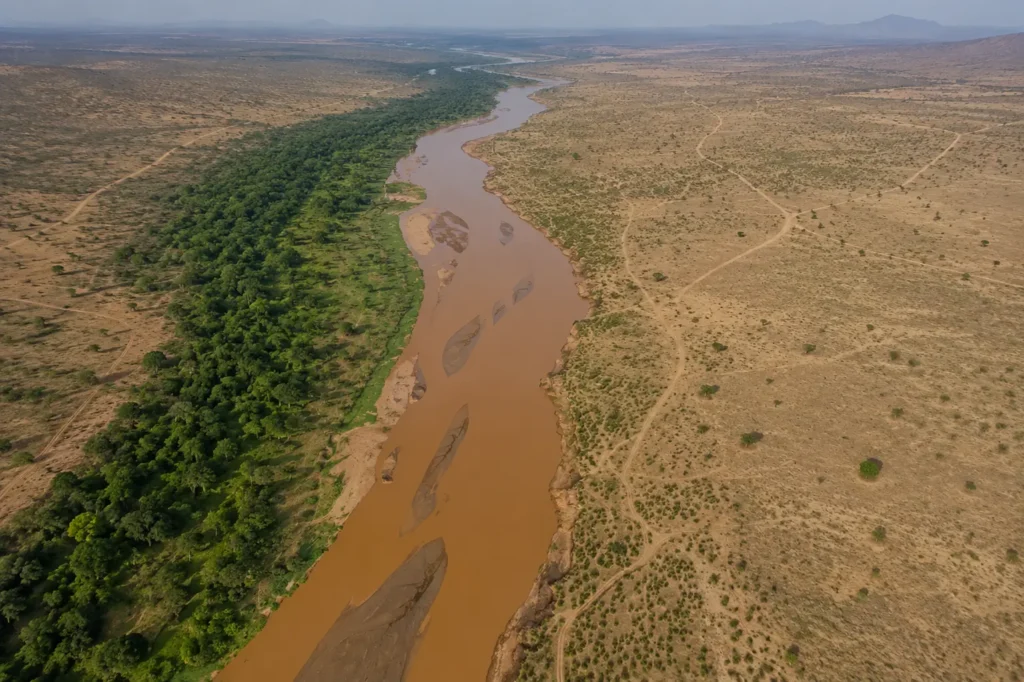
The Ewaso Ng’iro River cuts through the reserve and becomes the main lifeline.
Move away from it, and the landscape shifts quickly into dry scrub and open ground where water is scarce and vegetation thins out.
Grass doesn’t hold for long, and shade is limited.
That pressure forces change. Food is scattered, water is concentrated, and energy has to be managed carefully.
Animals here don’t just adapt slightly. They specialise.
Over time, those pressures shape how they look, how they move, and when they’re active.
The Special Five are not just different species. They’re five ways of making this landscape work.
Reaching higher: escaping competition instead of fighting it
On the ground, food doesn’t last. Grazers move through fast, stripping what’s available. What remains is either dry, already taken, or not worth the energy.
So pressure builds. Not to fight harder, but to feed differently.
Over time, certain browsers shifted upward.
Individuals that could reach slightly higher leaves, tolerate thorns better, or balance differently had an advantage.
They accessed food others couldn’t, especially in dry periods. That advantage compounds across generations.
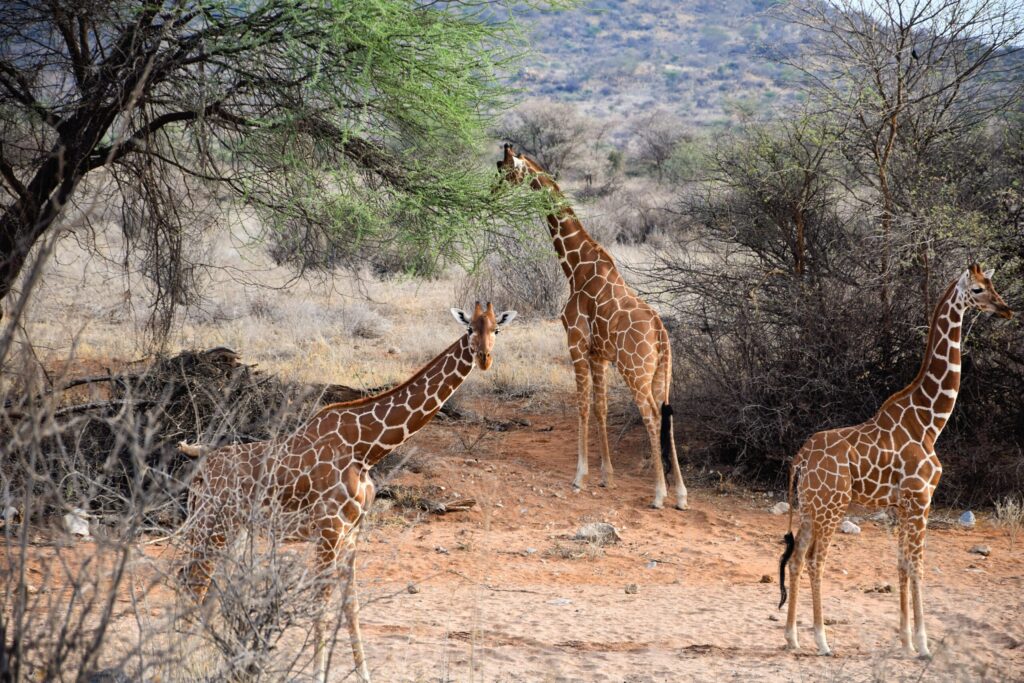
The Reticulated giraffe takes this to its limit.
Height becomes a feeding strategy. Longer neck, longer legs, specialised blood flow to manage that height, and a prehensile tongue built to handle acacia thorns.
It doesn’t rush. It selects. Energy is conserved because the food it reaches is less contested and more reliable.
The Gerenuk follows the same pressure, but solves it differently.
Instead of growing taller, it shifts posture. Standing upright on its hind legs, supported by strong joints and balance, it reaches into a vertical layer most herbivores ignore.
A longer neck and lighter frame make that possible. It doesn’t need to compete at ground level at all.
Same problem. Same landscape.
Two different evolutionary paths, both built on the same idea: if food is limited below, move above it.
Moving through the heat, not hiding from it
Midday in Samburu is not neutral. It shuts things down.
Most animals slow, rest, or disappear into shade.
Movement costs energy, and heat drains it fast.
For many, the safest strategy is to wait it out.
The Beisa oryx doesn’t follow that rule.
Over time, individuals that could tolerate higher body temperatures without damage had an advantage. That meant less reliance on sweating, less water loss, and the ability to stay active when others couldn’t.
Its pale coat reflects sunlight, and its metabolism is tuned to conserve moisture. It doesn’t avoid the heat. It manages it.
The Somali ostrich takes a different route.
Instead of resisting heat internally, it reduces its impact externally.
Long legs lift its body away from the hottest ground layer. Sparse feathering and exposed skin allow heat to dissipate more efficiently.
In open terrain, it relies on early detection and speed, not cover. If it needs to move, it can do it fast, even under pressure.
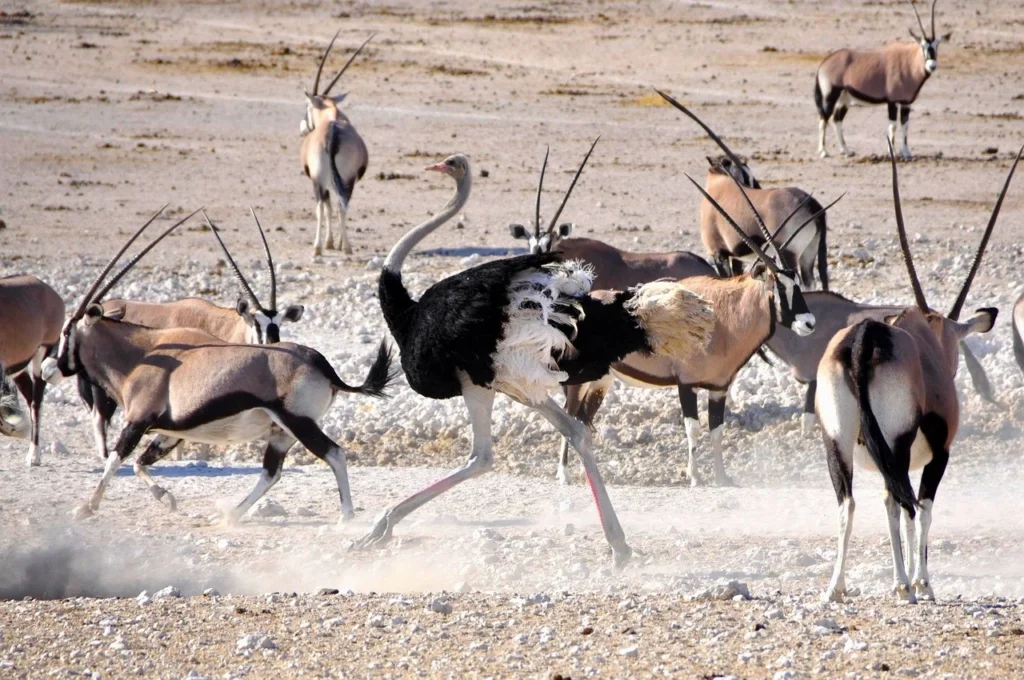
Two different strategies shaped over time.
One shared reality: heat that doesn’t go away.
When spreading out becomes the advantage
In richer ecosystems like the Mara, herd life works. Grass is widespread, water is easier to find, and moving in large numbers gives protection.
More eyes watching. More bodies confusing predators. The system supports it.
Samburu National Reserve doesn’t.
Here, grass appears unevenly and disappears fast.
Water is concentrated around the Ewaso Ng’iro River, especially during dry periods.
Large herds would strip an area quickly, forcing constant movement and heavier competition between individuals.
Over time, species that depended less on tight herd structures had an advantage.
Smaller groups meant less pressure on food, less conflict within the group, and more flexibility when conditions shifted.
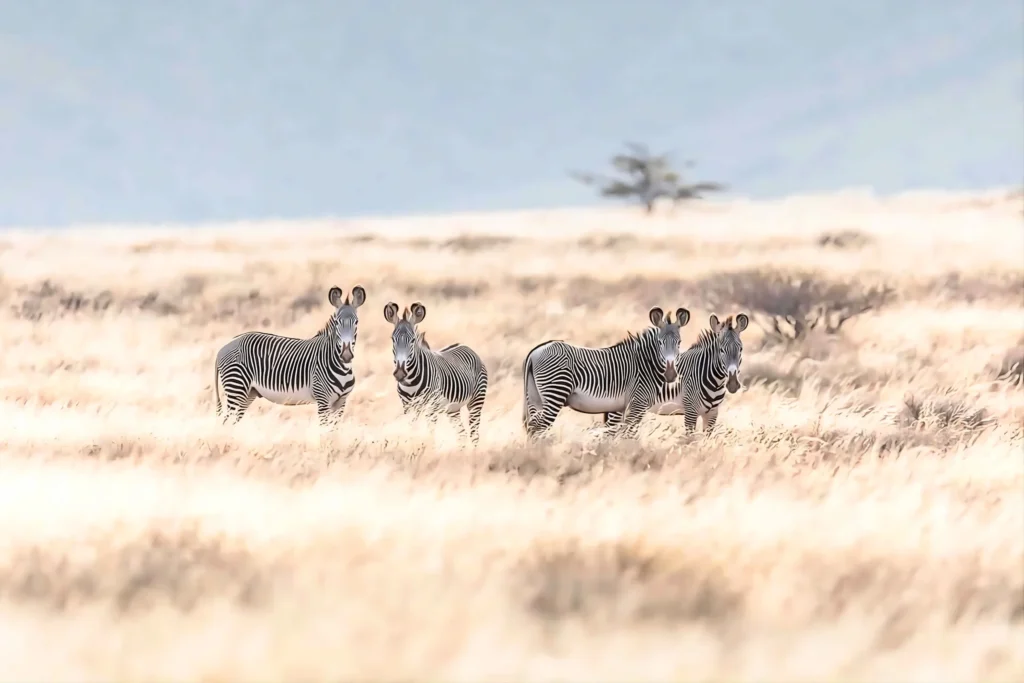
The Grevy’s zebra reflects that change clearly.
Unlike plains zebra, they spread out in loose groups and keep more distance between individuals. They still rely on awareness, but not in the same highly social way.
Even their bodies show the pressure of the environment.
Larger ears help release heat and pick up movement across open terrain.
Their thinner, tightly packed stripes create more contrast across the skin, helping disrupt heat buildup under direct sun.
They’re taller, leaner, and built to move efficiently across harder ground with fewer resources available.
You notice it almost immediately when you stop the vehicle.
They don’t crowd together. They drift apart, always leaving space between each other and the next patch of grass.
That distance is not random. It’s generations of adaptation written into behaviour.
Five different answers to the same harsh landscape
Seeing the Samburu Special Five is not impressive because they are rare. It’s impressive because all of them were shaped by the same harsh landscape, and somehow evolved completely different ways to survive it.
Heat. Distance. Dry ground. Limited water. Over generations, these pressures changed how these animals move, feed, cool themselves, and compete.
And only here do all five exist together.
You spend enough time in Samburu National Reserve and you start noticing it everywhere. The silence between sightings. Dust hanging in the air after a vehicle passes. A gerenuk balancing upright in dry scrub. Grevy’s zebra spread far apart across open ground. Nothing feels accidental.
It feels earned.
That’s what makes Samburu different from other safaris in Kenya. Less crowded. Less predictable. More raw.
And once it clicks, you stop looking for a checklist of animals. You start paying attention to the landscape that created them.
You don’t just come to Samburu to see wildlife. You come to understand what shaped it.